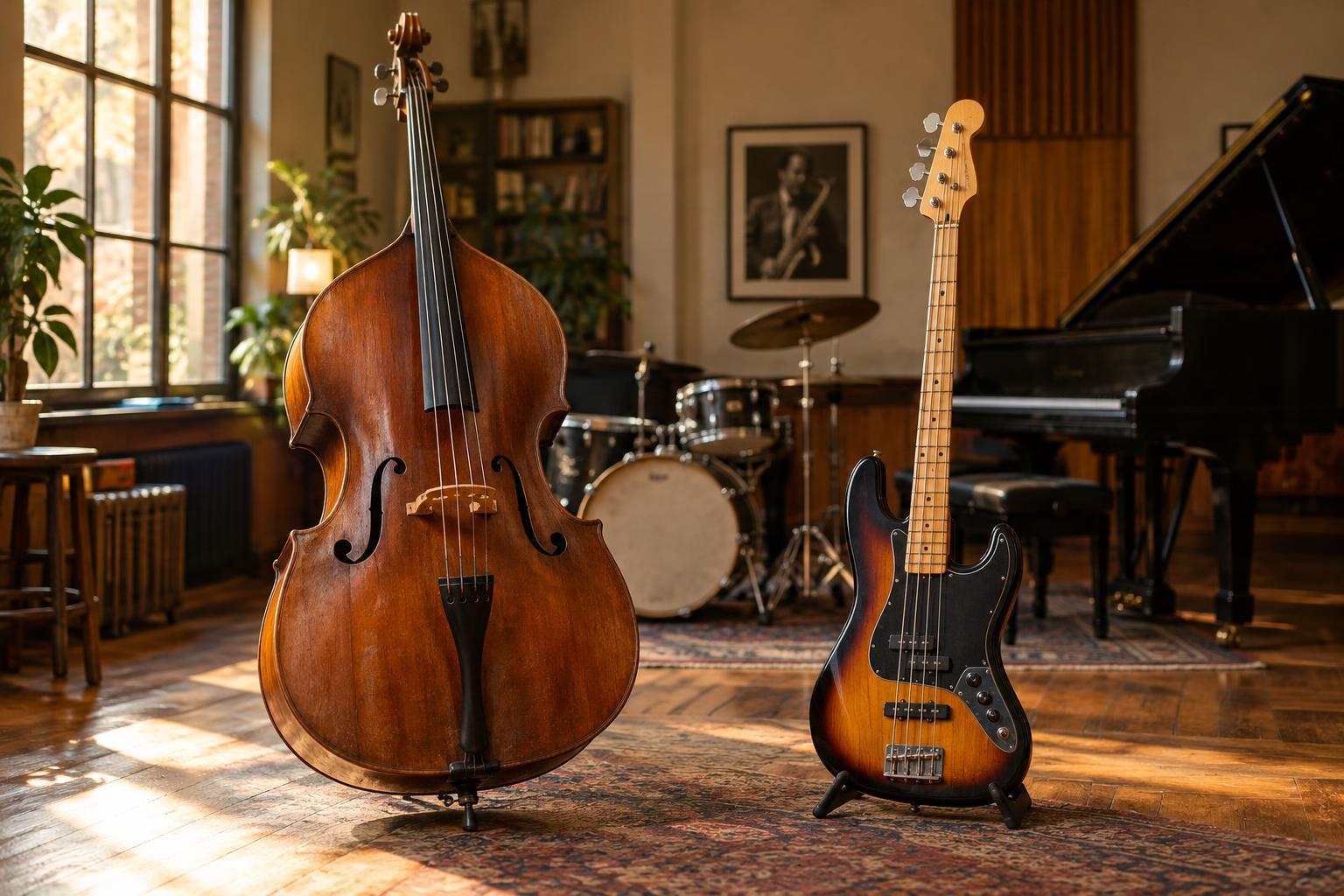
Two instruments, one foundation
In many jazz groups, the bass gives listeners a sense of where the beat sits and how the harmony moves. An upright bass and an electric bass can both do that job, yet the experience of following them may feel quite different. The distinction is not simply that one is traditional and the other is modern. Each instrument offers a range of sounds, and the player’s touch, the musical setting, and the recording or sound system matter as much as the instrument itself.
A useful starting point is to listen for the beginning, middle, and end of each note. Does it arrive with a woody thump or a more sharply defined edge? Does it fade quickly, or remain audible under the next chord? Those details influence how the bass connects the drummer’s pulse to the rest of the ensemble.
How the note begins and fades
A plucked upright bass often has a distinct attack followed by a relatively quick decay. You may hear the finger release the string, a little fingerboard noise, and the resonance of the large wooden body. In a walking line, that changing shape gives each note a clear arrival without requiring every beat to sound identical. The result can feel springy: the notes mark time while leaving room for the ride cymbal, piano chords, and soloist.
An electric bass often gives the player more control over a note’s length and an amplified sound that can stay prominent as it fades. The player can let notes ring, mute them for a short pulse, or use techniques such as slides and hammer-ons to connect them. A fretted electric may make a pitch’s edge especially clear; a fretless electric can produce a smoother transition between pitches. None of these traits is guaranteed. String choice, hand position, amplification, and the player’s approach can make either instrument sound round, crisp, restrained, or forceful.
Feel is a conversation, not a setting
In a swinging passage, an upright bassist might play one note on each beat while subtly varying its length and emphasis. That variation can make the line feel as though it is moving forward with the drummer rather than sitting beneath the band like a metronome. An electric bassist can create the same forward motion, but may choose a tighter, more even articulation or a longer, singing line. Listen to how the bass notes relate to the drummer’s cymbal pattern and bass drum: their timing together is a large part of the groove.
In music built around a repeating figure, an electric bass can make the pattern’s shape especially easy to follow. Sustained notes, precise muting, and a focused amplified tone may help a short phrase remain distinct as the arrangement grows denser. An upright can play a repeating figure too, with its percussive attack giving the pattern a different bounce. The feel comes from choices made by musicians in response to one another, not from a fixed rule attached to either instrument.
Finding space in the ensemble
An upright bass is commonly used to outline chord changes through a walking line, moving between roots, chord tones, and connecting notes. Its shorter-sounding notes can leave openings for a pianist’s lower register or a guitarist’s chords. In a quieter trio, the instrument’s body resonance and small changes in touch may become part of the group’s texture. Amplification can bring those details forward, though room acoustics and microphone placement can change what reaches the listener.
An electric bass may take the same harmonic role or become a more prominent melodic voice. Its capacity for sustained notes can support spacious arrangements, while short, muted notes can lock into a drum pattern. In a busy ensemble, that clear pitch and attack may help the bass line remain legible. At the same time, too much low-frequency overlap can make any bass hard to distinguish from the kick drum or low keyboard notes. Good ensemble playing involves choosing when to fill that space and when to leave it open.
A simple way to listen more closely
Choose two jazz performances with different bass instruments and follow only the bass for one full passage in each. First, tap the beat and notice whether the bass reinforces every pulse or places notes around it. Next, listen to how long each note lasts. Finally, pay attention to what happens when the drummer or chordal instrument changes its pattern. Does the bassist answer that change, hold the groove steady, or step forward with a new idea?
The goal is not to decide which bass is better. Try asking what each sound makes possible for the group. The upright’s attack and decay may draw your ear to the movement between notes; the electric’s sustain or sharply controlled articulation may bring a phrase into focus. Once you hear those choices as part of a conversation, the bass becomes more than a low-frequency foundation: it becomes a guide to how the whole ensemble works together.


