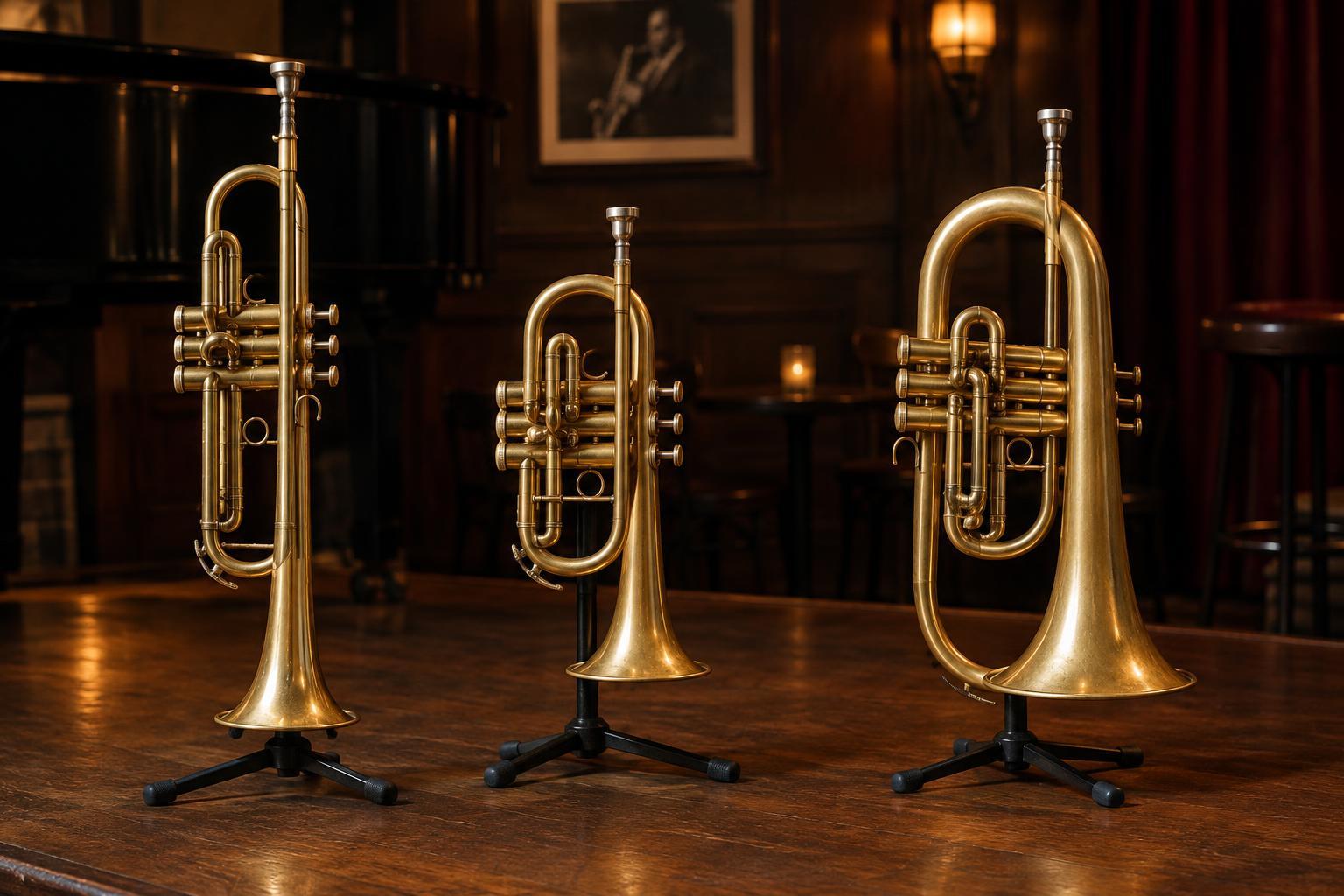
Three relatives, not three fixed sounds
A trumpet, cornet, and flugelhorn can all carry a melody over a jazz rhythm section. They are lip-vibrated brass instruments, and many players use similar fingerings on all three. Yet their notes can make different impressions: the trumpet often sounds direct and brilliant, the cornet more rounded, and the flugelhorn broader and softer-edged.
Those descriptions are starting points, not rules. The player's breath, embouchure, mouthpiece, register, articulation, and musical choices can change the sound dramatically. A gently played trumpet may sound warmer than a forcefully played cornet. A microphone or a crowded ensemble can also make distinctions harder to hear. Rather than trying to identify an instrument from one note, listen to how it begins, sustains, and ends a whole phrase.
Trumpet: a clear edge that can cut through
The trumpet's tubing is comparatively cylindrical through much of its length before it opens into the bell. Its characteristic sound often has a focused center and a pronounced edge, especially in the middle and upper registers. In jazz, that clarity can help a solo line remain distinct over drums, piano, guitar, and other horns. Short notes may feel crisp; a held note can project with considerable intensity.
That does not mean trumpet playing is always loud or sharp. A player can soften the attack, use a breathier tone, or shape a quiet phrase with great delicacy. Mutes add another set of colors, sometimes transforming the sound more noticeably than a switch between open brass instruments. When listening, compare an open trumpet's first instant of sound with its sustained tone: the attack often provides the strongest clue to its directness.
Cornet: a rounder voice with an agile feel
The cornet looks more compact than a trumpet because its tubing is wrapped more tightly. Its bore also becomes wider more gradually along its length. These features commonly give it a rounder, less piercing character, though the difference can be subtle. In a small group, the cornet may blend readily with clarinet or trombone while still moving nimbly through quick melodic lines.
Cornet has a strong association with early jazz ensemble playing, but it is not confined to one period or style. A player might choose it for its particular response or for the way its tone sits among other instruments. If you are comparing recordings, avoid assuming that every warm, compact brass sound is a cornet. Try listening for a combination of clues: a relatively gentle edge, clean movement between notes, and how the horn blends when several musicians play at once.
Flugelhorn: a broad sound with soft contours
The flugelhorn has a more conical bore than the trumpet and a wide bell. Listeners often describe its sound as mellow, dark, or velvety. It can make a melody feel intimate, particularly when a player leaves space between phrases or lets notes taper away. Its rounded attack and broad tone may be easiest to notice on sustained notes in a ballad or another spacious arrangement.
A flugelhorn is not simply a quiet trumpet. It can be played firmly, and its tone changes across registers. Its less pointed sound may also blend into a dense band texture, so a solo that seems unmistakable in isolation can be harder to identify in a full ensemble. Listen for the transition from the beginning of a note to its middle: compared with a typical open trumpet sound, the edges may feel smoother and the tone less concentrated.
A practical way to hear the differences
For a useful comparison, choose passages with similar musical conditions: open instruments rather than mutes, comparable registers, and roughly similar volume. Listen first to the attack of each note. Does it arrive with a bright point, a rounded start, or a particularly soft edge? Then follow a long note. Notice whether the sound feels tightly centered or spread across a wider tonal space. Finally, hear how the instrument fits beside the other musicians rather than judging it alone.
If the identity remains uncertain, that is part of the lesson. Different players can produce strikingly different sounds on the same horn, while skilled players can make these three relatives overlap. The most rewarding question is not always “Which instrument is that?” It may be “What does this sound allow the musician to say?” A bright accent, a buoyant ensemble line, or a warm, lingering melody can each reveal why a particular horn suits a particular jazz moment.


