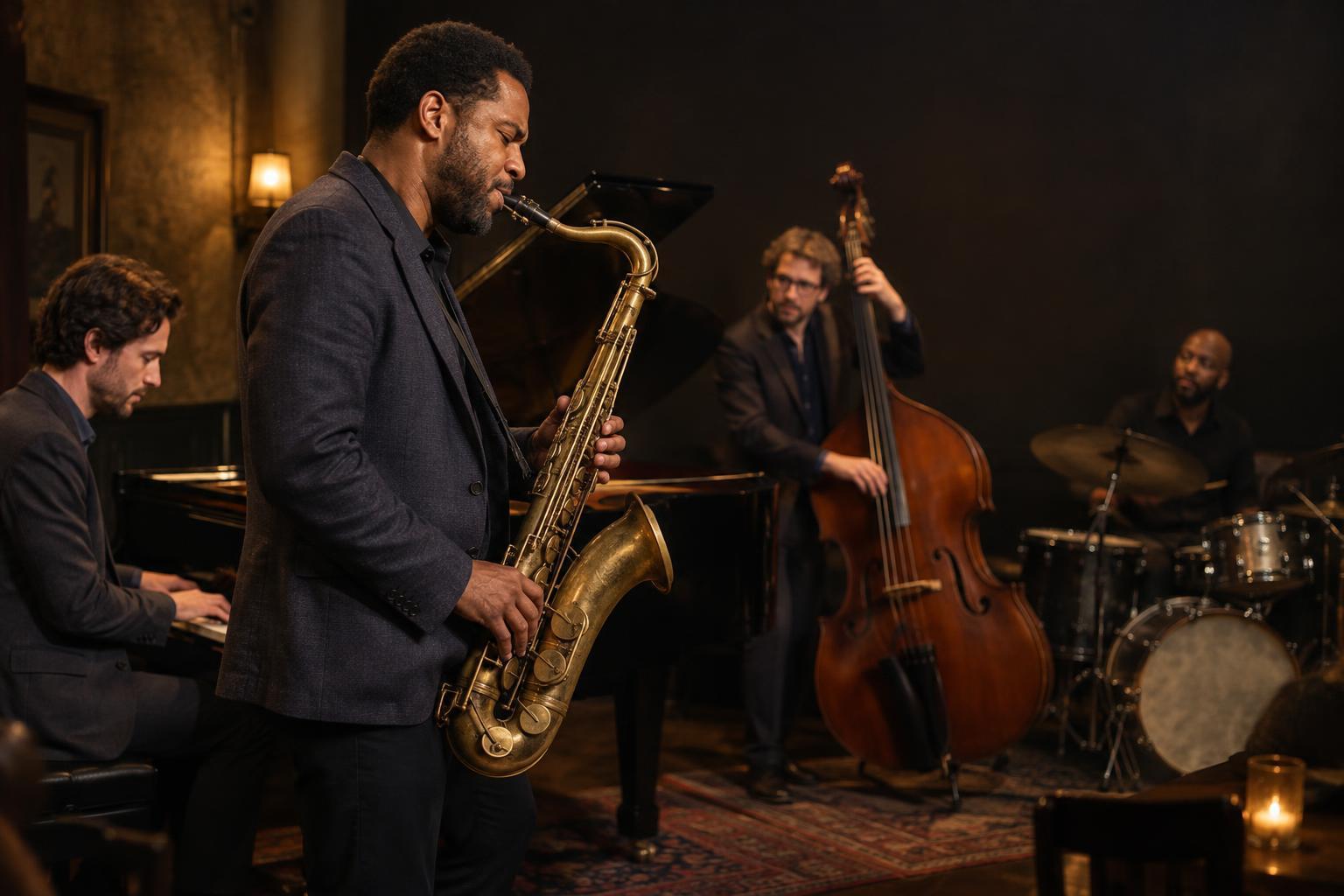
What comping adds to a solo
During a jazz solo, the pianist or guitarist often plays short chords behind the lead instrument. This accompaniment is called comping. It can help establish the harmony, but it also gives the performance rhythmic shape. A chord may land just as a solo phrase begins, punctuate its ending or add a burst of energy between phrases.
Comping is easy to miss because it is not usually the loudest part of the group. Try listening to a recording you know and shifting your attention away from the soloist for thirty seconds. You do not need to identify the chords. Notice when the accompanying instrument plays, when it holds back and how each choice changes the feel of the solo.
Start with the spaces between chords
Rather than trying to follow every note, listen for the pattern of sound and silence. Does the accompanist play a chord at regular intervals, or leave several beats open before adding another? Are the chords brief and clipped, or do they ring beneath the soloist? These differences can make the same underlying pulse feel relaxed, busy or insistent.
A useful exercise is to tap the beat gently while listening to the chord attacks. You may hear a chord on a strong beat, between beats or close to a drum accent. If the pattern changes, keep tapping and notice whether the shift makes the music feel more active. The goal is not to judge whether a chord is early or late; it is to hear how its placement works within the group.
Hear how the texture changes
Comping can be sparse or dense. One accompanist might use isolated chords with plenty of room around them; another might play a run of closely spaced chords during an intense passage. Listen for changes within a single solo. A pianist who begins quietly may gradually add more notes or play more often as the solo develops.
Also pay attention to the sound of each chord. Some voicings have a light, open quality, while others sound compact or weighty. A guitarist may use a dry, percussive attack; a pianist may let a chord sustain. You do not need music-theory terms to describe what you hear. Words such as bright, dark, short and ringing are useful starting points, especially when you compare two moments in the same performance.
Listen for a changing relationship
The accompanist is not simply filling every gap the soloist leaves. Sometimes a chord follows a solo phrase like a small reply. At other times it arrives underneath a long note, giving that note a different color. The accompanist might become quieter when the soloist plays a delicate passage, or more forceful as the group builds energy.
Avoid assuming that every change is a direct reaction. Musicians can also be following the tune’s structure or a shared sense of where the performance is going. For a practical listening exercise, choose one minute of a solo and hear it twice. First, follow only the soloist’s phrases. Then replay it while tracking only the chords behind them. On a third pass, listen to how the two parts fit together.
Keep the whole group in view
Comping makes the most sense in context. The bass may provide a steady line while the drummer marks time or adds accents of their own. Against that foundation, a pianist or guitarist has room to place chords selectively. If the bass and drums are already creating a strong rhythmic texture, fewer chords can still have a noticeable effect.
On your next listen, pick one short stretch of a solo and ask three questions: How often do the chords appear? What happens to the energy when they do? Do they leave the soloist room to be heard? Those questions can turn a part that once seemed like background into one of the most engaging things happening in the music.


