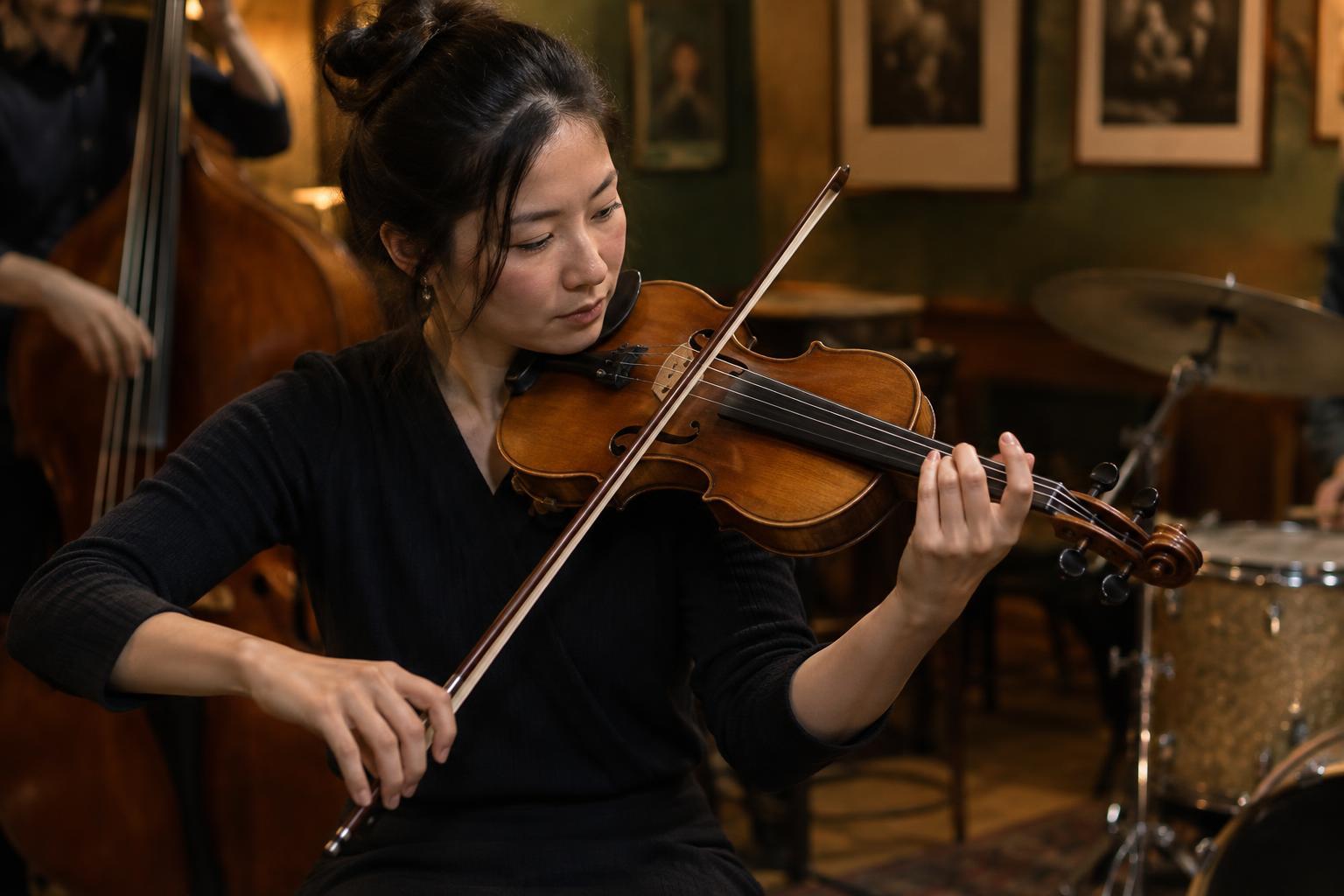
Two Ways to Start a Note
A violinist usually makes a sound by drawing a bow across a string. This is called arco playing. The bow can keep a note sounding, connect it smoothly to the next one or give its beginning a sharp edge. Pizzicato means plucking the string with a finger instead. The resulting note has a clear attack and fades more quickly. Jazz violinists use both approaches, sometimes within the same phrase.
Neither technique has a fixed role. Bowing is not always lyrical, and pizzicato is not always playful. A short bow stroke can sound crisp and rhythmic; a carefully placed pluck can be quiet and spacious. Listen for the length of each note as well as its beginning. That difference often tells you more about a player’s intention than the technique alone.
How the Bow Shapes a Jazz Phrase
The bow lets a violinist vary a note after it begins. A player can lean into its middle, ease away at the end or change its color by adjusting bow speed and pressure. This flexibility is useful when stretching a melody over the beat or giving a held note the inflection of a sung phrase. Slides and vibrato may add expression, but they are choices, not requirements of jazz violin.
Bowing also contributes to swing and articulation. A violinist might connect several notes in one bow stroke, then separate the next few to make a rhythmic figure stand out. Quick, light strokes can leave space around the beat, while stronger attacks can mark an accent. Because a bowed note can continue under changing chords, the player can create tension simply by holding it and deciding when to release it.
What Pizzicato Adds
Plucking changes the violin’s relationship to the rhythm section. A pizzicato note is brief enough to sit beside a piano chord, drum accent or bass note without sustaining across it. In a solo, a violinist might pluck a repeated figure to make its rhythm more prominent, or leave gaps between notes so another musician can answer.
The violin’s pizzicato does not have to imitate a double bass. Its shorter strings and higher register give plucked notes a different weight and decay. That contrast can be useful: a high pluck may sound like a small punctuation mark above the bass line. Players can also vary the force and placement of a pluck, producing anything from a gentle touch to a more percussive snap. Those sounds work best when heard as parts of a phrase, rather than as effects added for their own sake.
Switching Techniques in an Ensemble
Moving from bowing to pizzicato can mark a change in musical role. A violinist may bow a melody over the group, then pluck short responses while another instrument solos. The reverse can make an entrance feel expansive: after a passage of clipped notes, a sustained bowed line suddenly occupies more space. A switch need not be dramatic, though. One plucked note at the end of a bowed phrase can act like a full stop.
Context matters. In a busy ensemble, the fading sound of pizzicato may be hard to hear without amplification, while a sustained bow can remain distinct. In a sparse passage, even a soft pluck may draw attention. The most effective choice depends on register, dynamics and what the other musicians are playing. It is worth listening for moments when the violinist leaves room rather than trying to fill every beat.
A Simple Way to Listen
Choose a jazz violin performance and follow one short passage without trying to identify every note. First, notice which sounds sustain and which fade almost at once. Then listen again for the shape of their entrances: are the notes smooth, sharply bowed or distinctly plucked? Pay attention to what happens when the violin changes approach. Does the rhythm feel lighter? Does the melody come forward?
Finally, listen to the other instruments during those changes. A plucked violin figure may join a rhythmic conversation, while a bowed line may float above it or press against it. Bowing and pizzicato are not simply two violin sounds; they are ways for a player to choose how long to speak, where to place an accent and when to let the rest of the band be heard.


