Two instruments, one rhythmic conversation
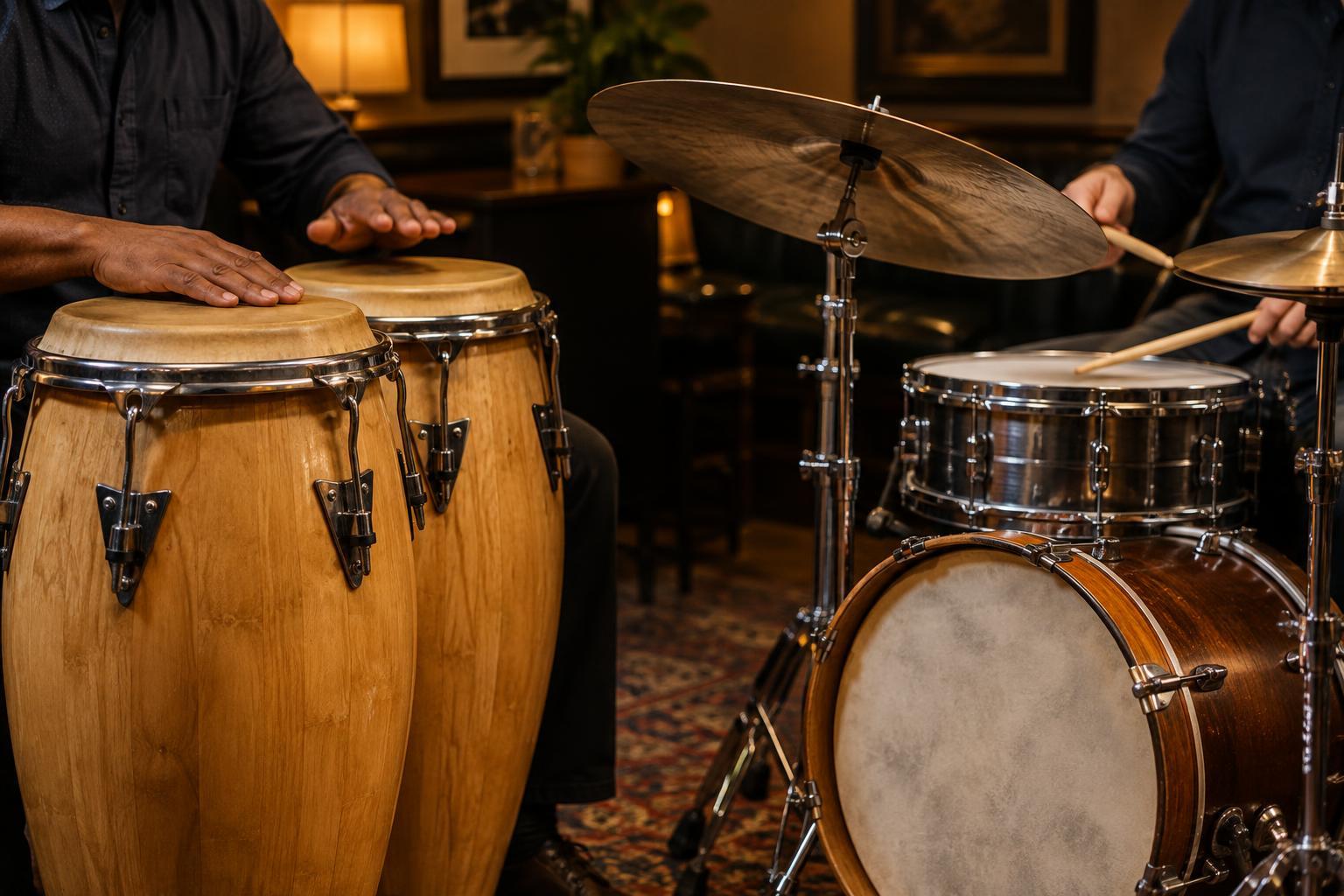
In a Latin jazz group, the conga player and drum kit player may both keep the music moving, but they need not mark time in the same way. Congas bring pitched hand-drum sounds and patterns that can make a groove feel circular. The kit can connect those patterns to the rest of the band with cymbals, snare, and bass drum. Their roles change with the tune: a small ensemble may give one player more space, while a larger group can divide the rhythmic work among several percussionists.
The useful listening question is not “Which instrument has the beat?” but “How do their parts fit together?” A conga phrase may answer a bass line, while a cymbal pattern gives the soloist a steady point of reference. At another moment, the drummer may leave that steady pattern behind and respond to short phrases from the horns. Latin jazz draws on more than one rhythmic tradition, so there is no single arrangement that describes every performance.
What the congas contribute
A conga player can draw several contrasting sounds from the same drum. Open tones ring clearly; muted tones are shorter; slaps can add a sharp accent. Softer hand movements create quieter notes between those more noticeable sounds. Players often use congas of different sizes, allowing a pattern to move between lower and higher tones. This range lets the congas carry a recognizable rhythmic line without relying on the bright metal sounds of a kit.
In many Afro-Cuban-influenced settings, a repeating conga pattern is called a tumbao. Rather than striking every beat equally, it places tones and accents so that the spaces between notes matter. A bass player may reinforce part of the pattern while placing other notes around it. Listen through a few repetitions: what first sounds like a busy set of taps may become a clear phrase with a beginning, an answer, and a return.
What the drum kit contributes
The drum kit offers a different palette. A ride cymbal or hi-hat can provide a continuous, lightly articulated pulse. The snare can add crisp responses or softer texture, and the bass drum can give low accents that are felt as much as heard. Because one player can combine these sounds at once, the kit can outline the overall shape of the music while leaving room for the congas to make their pattern distinct.
A kit player does not have to impose a conventional jazz swing pattern over a Latin groove. Depending on the arrangement, the drummer might use cymbal and snare sounds sparingly, support accents shared by the ensemble, or shift approach when a solo begins. Kit vocabulary and hand-percussion vocabulary can meet without becoming identical. The contrast between a cymbal’s sustained shimmer and a conga’s rounded, brief tone is often part of what makes the combined rhythm easy to follow.
How the parts avoid getting in each other’s way
When both players are active, cooperation matters as much as complexity. If every instrument emphasizes the same moment at full volume, the groove can lose its shape. One player may hold a repeated figure while the other adds occasional accents. They may also share a phrase across instruments: a conga tone sets it up, and a snare or cymbal hit completes it. Those choices give the listener distinct layers instead of one dense stream of attacks.
You may hear musicians refer to clave, a recurring rhythmic framework important to many Afro-Cuban styles. It can help organize where phrases settle and where they create tension, even when no one is striking the pattern explicitly. Not every Latin jazz piece uses clave in the same way, and some draw more strongly on other traditions. For a listener, the practical point is to notice how repeated accents relate across the band, rather than trying to force every sound into one fixed pattern.
A simple way to listen
On your first pass through a recording, follow the congas alone. Notice which tones ring out and which sounds fill the gaps. On a second pass, follow the kit: is the cymbal marking a steady flow, or does the drummer mostly punctuate the ensemble? Then listen for the bass, piano, and horns. Their phrases can reveal why a percussion accent lands where it does.
Finally, pay attention to changes. The congas might continue a familiar figure as the drummer becomes busier behind a solo, or the kit might simplify when the ensemble returns to a composed melody. These shifts can be subtle, but they show how percussion supports form as well as groove. The goal is not to identify every stroke. It is to hear two players making different choices that give the whole group room to move.