Two ways to make the beat heard
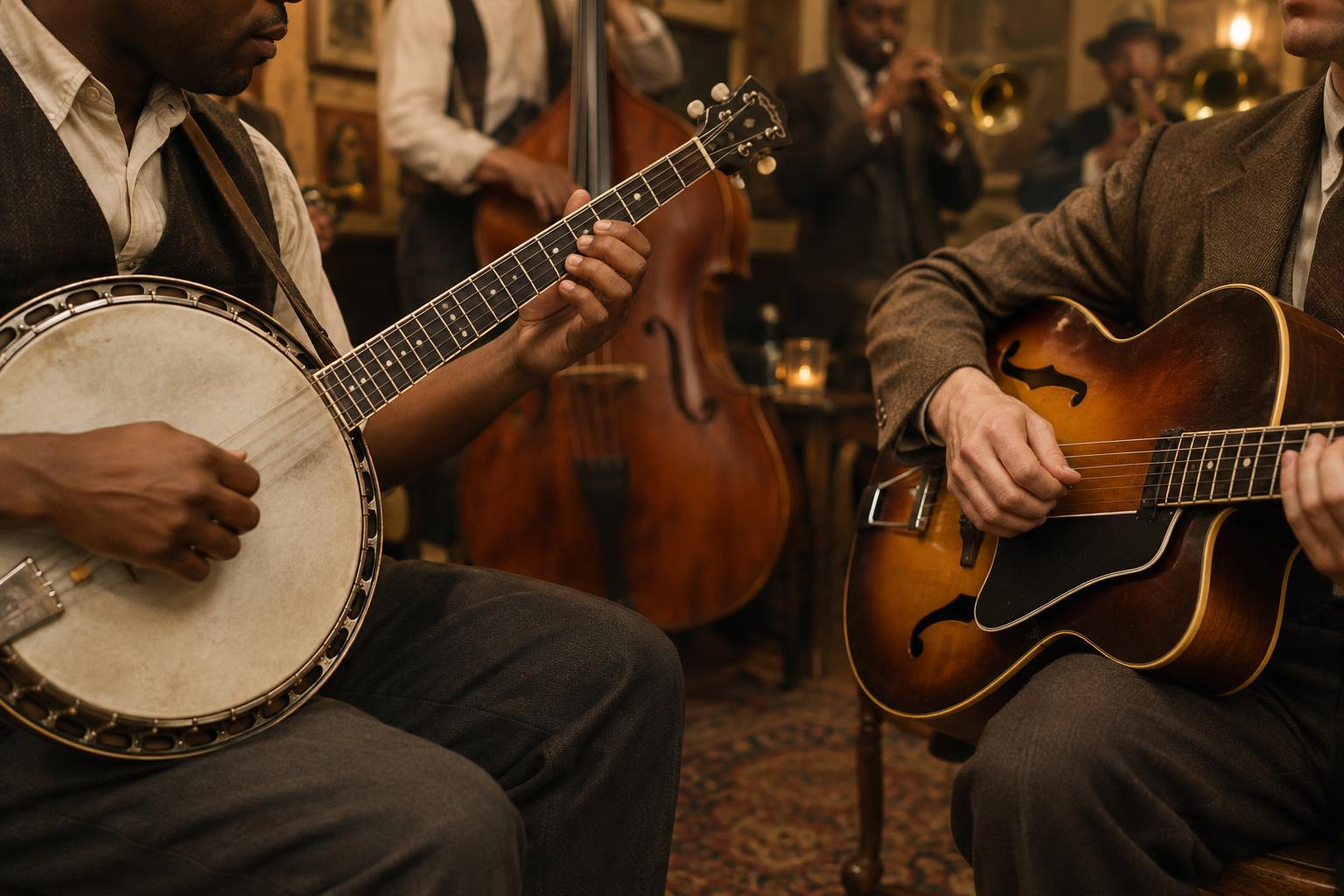
In an early jazz ensemble, the rhythm section did more than keep time. It gave the horns a steady foundation, marked changes in the harmony and helped the music feel ready to dance. Banjo and guitar could both fill that role, but they made different impressions. A banjo’s short, bright attack can sound like a series of crisp taps. A guitar, especially one played without amplification, tends to offer a rounder sound that fades more gently.
That difference matters when you listen to a band as a whole. Behind a cornet, clarinet and trombone, the banjo may be easy to pick out even when it plays simple chords. A guitar can be less obvious, yet its repeated strokes still help define the pulse. Neither instrument is inherently the better rhythm keeper. The useful question is what each one contributes to the particular ensemble and recording.
Why banjo worked so well in busy ensembles
The banjo’s vibrating membrane head gives plucked notes a sharp beginning and relatively quick decay. In a group with several acoustic instruments playing at once, that attack helps chord strokes remain distinct. Many early jazz banjoists used a pick to play compact, regular chord patterns. Instead of drawing attention to a long ringing note, they could punctuate each beat and leave space for the next sound.
The word “banjo” does not describe just one instrument or tuning. Tenor and plectrum banjos, for example, have different necks and playing conventions. For a listener, the distinction may be less important at first than the instrument’s rhythmic effect: listen for a dry, percussive chord sound sitting beneath the melody. A player might also vary accents, add passing chords or briefly break into a melodic figure. The part may be repetitive, but it need not be mechanical.
What guitar brought to the rhythm section
Guitar offered its own way of connecting rhythm and harmony. Strummed chords can make a continuous cushion for the band, while a picked bass note followed by a chord can suggest movement between beats. The instrument’s lower strings also give a player options that are less prominent in a typical banjo chord part. Depending on the arrangement, a guitarist might stay close to the pulse, answer a melodic phrase or add a small run between chords.
Hearing an acoustic guitar in an old ensemble recording can take patience. A soft guitar is easily masked by louder instruments, and recording conditions affect what reaches the listener. A faint part is not necessarily an unimportant part: musicians playing together can hear and respond to details that a recording does not preserve clearly. Rather than judging the rhythm section only by volume, notice whether the chords give the music a smooth, settled motion.
A change in balance, not a clean handoff
It is tempting to tell the story as banjo first, guitar later. That is a useful starting point, but it is too neat. Instrument choices varied among bands, settings and players, and banjo and guitar could appear in overlapping periods. A group’s size and sound mattered, as did the practical question of whether a rhythm instrument could be heard alongside the horns. As jazz ensembles and recording practices changed, guitar became an increasingly workable choice in more settings.
The instruments also encouraged different textures without dictating a single style. A banjoist can play lightly; a guitarist can make a firm, driving beat. Likewise, a guitarist’s part is not automatically more subtle or a banjoist’s part more old-fashioned. Treat the instrument as one clue among several. The bass instrument, drums, horn arrangement and player’s touch all shape how the rhythm section feels.
How to compare them by ear
Choose two early jazz performances with reasonably clear rhythm sections, one featuring banjo and another featuring guitar. On the first listen, follow the melody. On the second, shift your attention to the space between horn phrases. Can you hear a sharp chord on each beat, or a softer wash of strums? Does the player emphasize every beat evenly, or make some beats feel stronger? If the guitar is hard to isolate, listen for the combined pulse rather than trying to identify every stroke.
Finally, pay attention to what happens when a soloist enters. Does the chord instrument become more restrained, or does it maintain the same pattern? Do its accents make the solo feel buoyant, relaxed or insistent? These questions turn a simple banjo-versus-guitar comparison into a broader listening habit: hearing how rhythm players support a group without needing to be its loudest voices.